Every tag, every serial, one searchable register
Register installations, plants, systems and tags in one taxonomy, and keep every change-out on the record
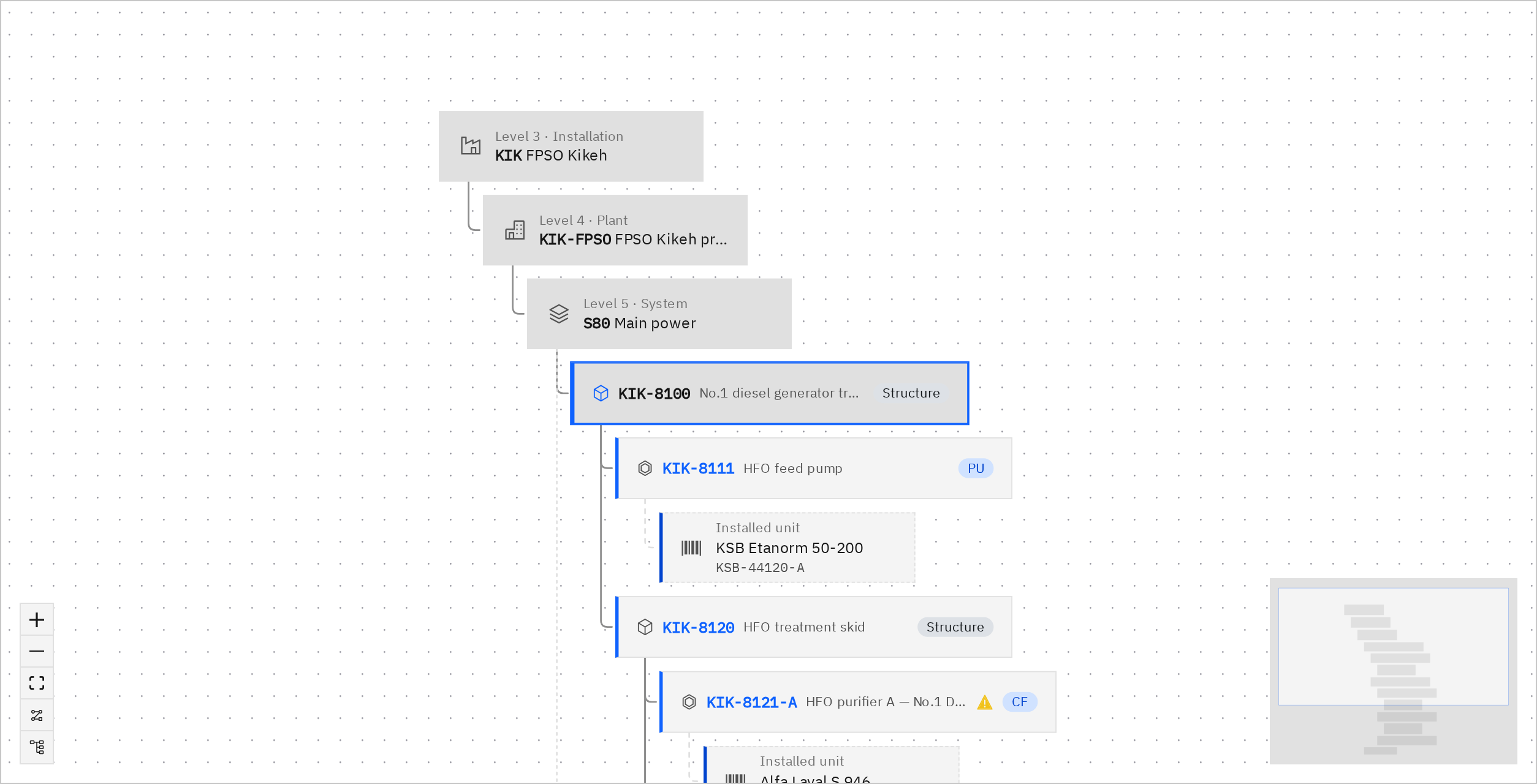
A data model, not a folder tree
Most registers are folders with names. Magnus Reactor gives every asset a place in the nine-level taxonomy of ISO 14224: industry, business category, installation, plant, system, tag, subunit, maintainable item and part. The path is data, so each record knows its installation, plant and system without anyone typing them twice, and every filter and search works against the same fields.
The tag is the function and the place; the installed unit is the serial that does the job today. They are separate records, joined by an installation history, so a change-out swaps the serial and keeps the tag, its class, its safety-critical flag and everything ever recorded against it.
Walk the nine levelsBenefits
Keep the tag when the unit changes
Swap an overhauled pump into KIK-8121-A and the tag keeps its identity, its class and its record. The serial changes; the history grows by one installation.
Find any asset in a few keystrokes
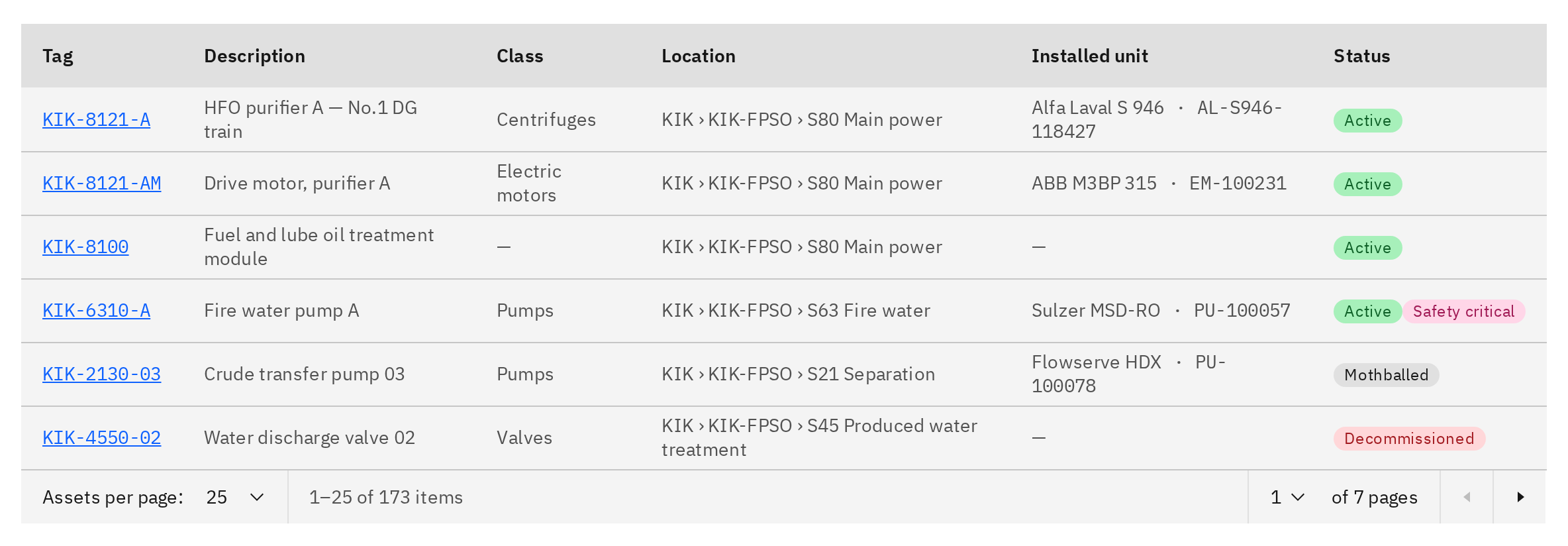
Type a tag fragment, a serial, a manufacturer or a misspelled description and the register returns matches ordered by relevance, with class, status, kind and safety-critical filters to narrow the list.
See the hierarchy from hull to serial
Open any tag and see its installation, plant and system above it, its modules and skids around it, and every descendant with its installed unit below, as a flow or an indented tree.
Classify with a vocabulary every site shares
Pick equipment classes from the standard's Table A.4, such as PU Pumps, CO Compressors, VA Valves and EM Electric motors, or author your own under the same eleven categories, so failure and maintenance data compares across installations.
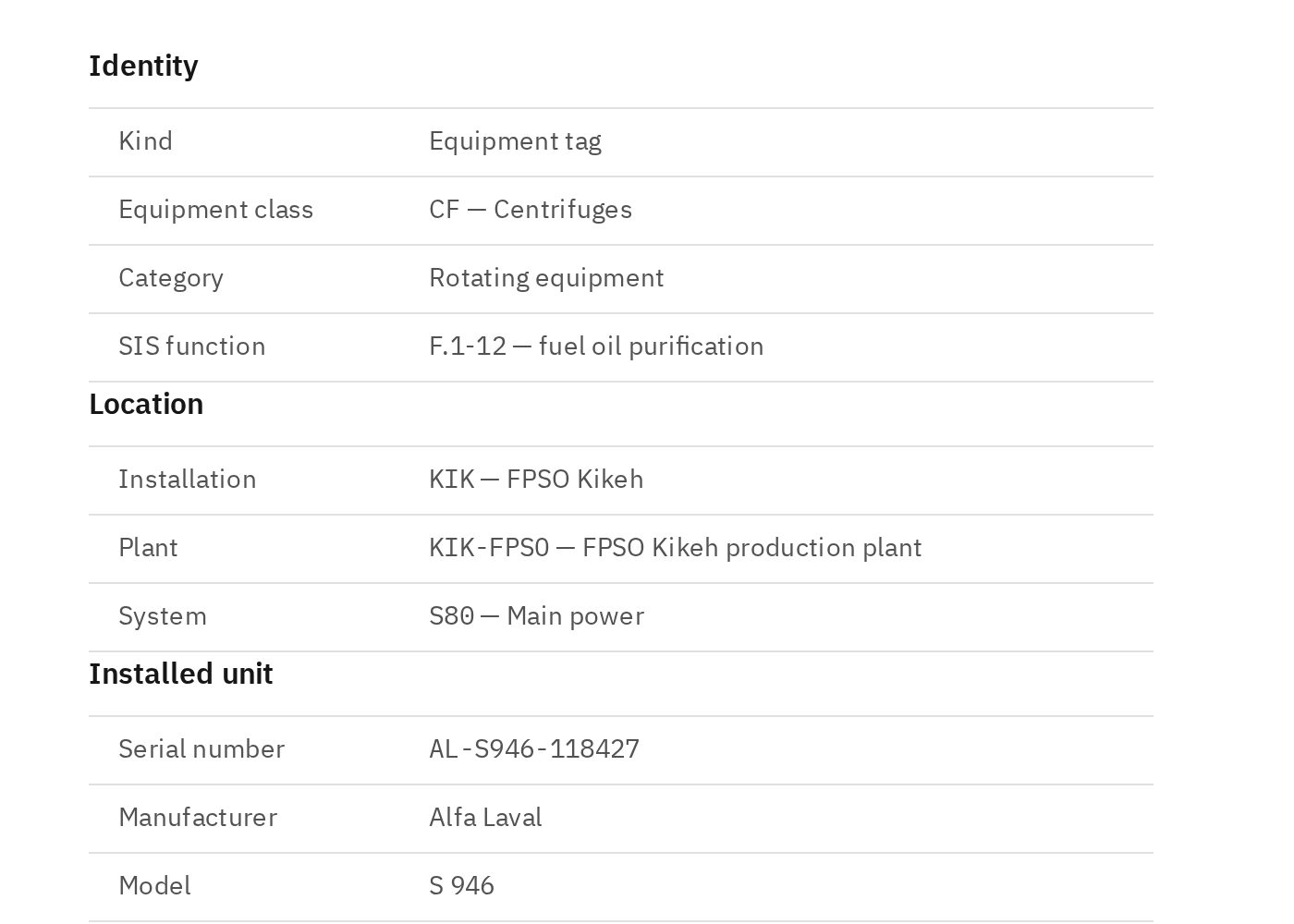
An equipment record
Key capabilities
Search by tag, description, class, unit or location from one box. Matching runs on stemmed words, substrings and close misspellings across the tag number, description, SIS function, remarks, equipment class, the installed unit's manufacturer and model, and the installation, plant and system codes and names. Results come back ordered by relevance, each row showing its class, its location path, its installed serial and its status. Narrow the list by equipment class, status, kind or safety-critical only, then page through the numbered results.
A functional location is the tag: KIK-8121-A, its description, its equipment class, whether it is safety critical, its SIS function and its status, active, mothballed or decommissioned. An equipment unit is the serial: manufacturer, model, equipment type, technology generation, normal operating state, commissioning date and whether it is in service, spare, in repair or scrapped. Drivers are their own units, linked to what they drive. The two records meet only through an installation, so a spare on the shelf and a unit in a workshop are as real as the one running today.
Each installation records which unit sat at which tag, from the day it went in to the day it came out, and why it came out: replacement, overhaul, modification or decommissioning. A tag holds at most one open installation and so does a unit, so the register cannot show a serial in two places or two serials at one tag. Swap a unit and the old installation closes, the new one opens, and the record you read next month explains what was running on the day a failure was reported.
Record failures against the installed unitEquipment classes are reference data, not a dropdown someone typed once. The register ships the classes of ISO 14224 Table A.4 with their codes, PU, CO, VA, EM and the rest, grouped under eleven categories from rotating and electrical to subsea and marine, each with its design types. Add company-authored classes alongside them, scoped to your organization, and they appear in the same filters and forms. Because each class carries whether a change-out resets the reliability clock, the classification you choose today still means something when the analysis is run.
Choose the Flow layout for a left-to-right chart or the Tree layout for an indented list, and the browser remembers your choice.
Follow the path from industry to part
Nine levels, one path
Every asset sits on one path from the industry it serves to the part fitted in it. Levels one to five say where; six to nine say what.
Industry
Petroleum, natural gas or petrochemical. Level one is set once on the installation and never typed again.
Business category
Upstream, midstream, downstream or petrochemical. Level two tells the analysis which benchmarks a failure rate should be compared with.
Installation
The facility: an FPSO, a platform, a refinery, a floating LNG unit. Codes are unique per organization, with a category, a geographic location and remarks.
If it has a hull, it is level three
Plant
A process plant or unit on the installation, such as an LNG liquefaction train. Your organization is the operator, so there is nothing else to fill in.
If it has a process, it is level four
System
A coded system on the plant, S80 Main power or S63 Fire water, marked manned or remote controlled.
Tag and installed unit
The functional location, KIK-8121-A, with its class and safety-critical flag, and the equipment unit installed there today, by serial, manufacturer and model.
Subunit
The subdivisions the class defines for that unit, such as a pump's driver, lubrication, or control and monitoring.
Maintainable item
The item a work order actually repairs or replaces: a bearing position, a seal, a coupling.
Part
The part number fitted at that position, so consumption on a work order lands where it belongs.
Part of one record
Every other record in Magnus Reactor cites a tag and an installed unit, so the register is where the rest of the product begins.
Work Orders
Cite the tag and unit on every job
Every work order and failure event in Work Orders names a tag and the unit installed there at the time, so the serial takes its record into the workshop and the tag keeps the history of the function.
Inventory
Build the as-built BOM on the unit
Levels eight and nine on the installed unit carry part numbers and quantities from Inventory, so where-used and consumption on a work order resolve to a real position on a real serial.
IoT & Metering
Count hours and demands per unit
Surveillance periods, operating-hours readings and test records in IoT & Metering attach to the installed unit, so a change-out starts a clean clock when the equipment class says it should.
Attachments
Keep documents where the equipment is
Attachments hang from the tag for the function and from the unit for the serial, so the manual travels with the pump and the drawing stays with the location.
Questions we are asked
Nothing is lost and nothing is overwritten. The tag keeps its identity, class and every record raised against it. The outgoing unit's installation closes with a removal reason, the incoming unit's opens, and both serials keep their own design and commissioning data. Ask later what was installed on a given date and the answer is on the record.
No. Pick a class once and the register does the coding. Nobody sees a list they do not need: a pump tag never offers a mooring failure, and the forms filter to what applies. The class codes exist so the data compares across sites and reads into reliability tools, not so a mechanic memorizes them.
Yes. Company-authored classes sit alongside the standard ones under the same eleven categories, scoped to your organization and shown in the same filters, dropdowns and forms. Standard rows stay as published, so an extension never changes what an existing code means.
Between the system and the tag. A structure tag is a navigation node for a module, skid or package, such as a fuel and lube oil treatment module. It carries no class and no unit and raises no events; it exists so the hierarchy chart reads the way the deck is laid out.
Yes. An organization is the operating company; each facility is an installation under it with its own plants, systems and tags. Tag numbers are unique per installation, serials per manufacturer, and every search and filter can be scoped to one installation, plant or system or run across all of them.
With a flag on the tag and an SIS function reference, so safety-critical tags filter out in one click and their failures carry the classification the standard expects. There is no scoring model to maintain: the flag states a fact about the function, and the reliability analysis reads it.